

Choose a team
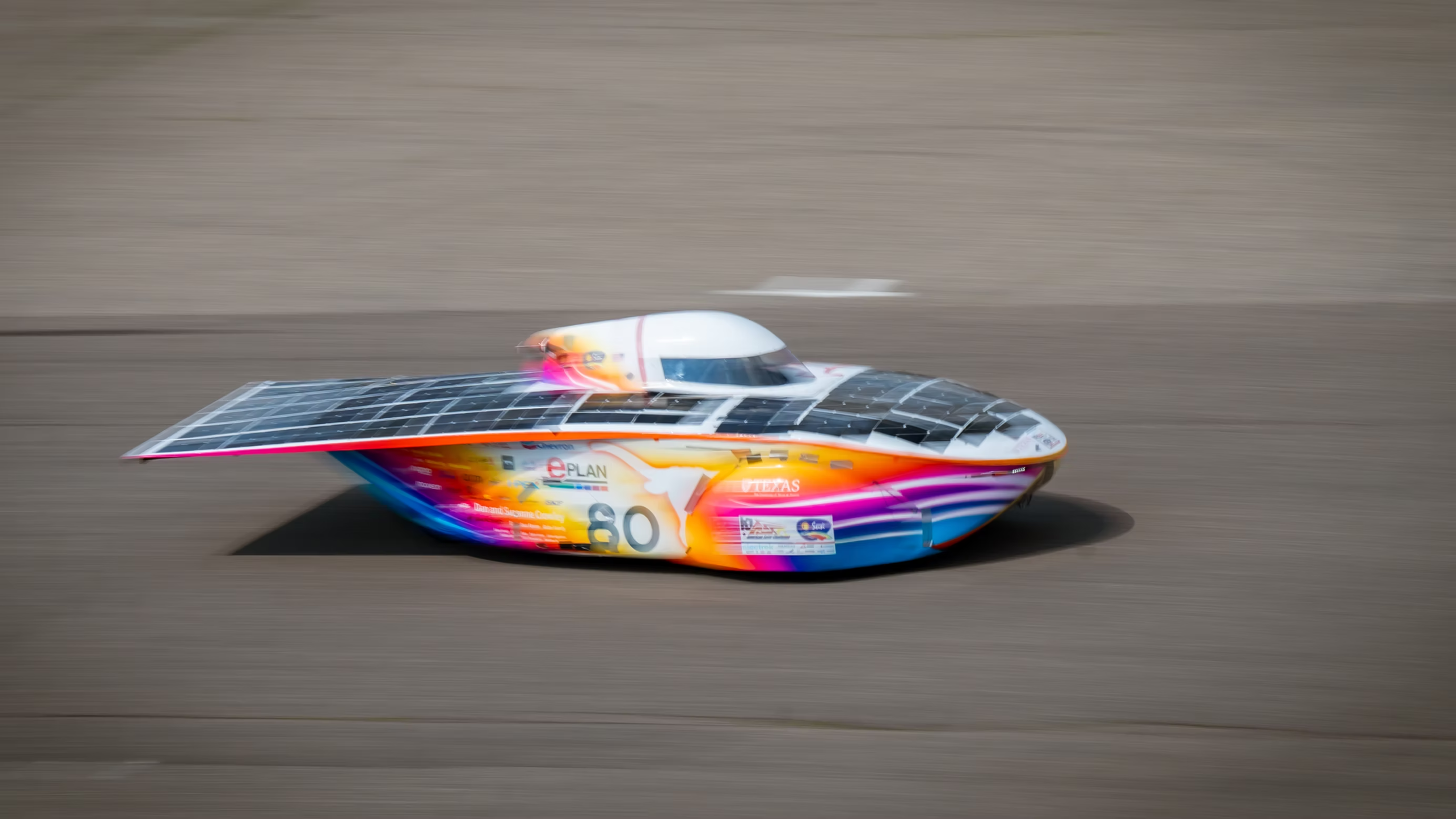
Longhorn Racing Solar
LHRsFounded in 1988 as one of the first ten teams competing in the American Solar Challenge, Longhorn Racing Solar designs and builds innovative, road-legal solar vehicles. From a custom electronics package and high-voltage battery to a carbon-fiber composite chassis and streamlined aerodynamics package, we iterate on each component relentlessly. Our vehicles prove what’s possible when engineering meets endurance and sustainability.
Every year, LHRs competes in the Formula Sun Grand Prix (FSGP), where teams race head-to-head to complete as many laps as possible using only solar power. This past July, our latest car “High Noon” breezed through technical inspections and placed #18 out of 47 total entrants, completing a total of 59 laps (183 miles) over three days of endurance racing. The 2026 season was a resounding success for LHRs, as we executed on an ambitious timeline and started on the grid at FSGP for the first time in over a decade!
Every two years, we re-design and manufacture the chassis, aeroshell, dynamics, and ergonomics components. Our electrical and powertrain systems operate on a one-year cycle, building a new battery pack each year, along with several custom circuit boards and a robust wire harness. As we enter a new design cycle, we’ve set high expectations – we’re aiming to build the lightest, fastest, and most efficient LHRs car so far.
Our workdays are Saturdays from 10am to 7pm, with weekly system meetings to continue work on design and manufacturing. Additionally, our members consistently spend time making progress on projects, running test days, and working across systems to integrate electronics with mechanical parts of the car as we continue to push towards our timeline goals.
We value members who are curious, dependable, proactive, and take initiative to support the team. We don’t require any technical experience, however we do ask that you’re willing to learn, put in time and effort, and work collaboratively with others to solve complex problems. We look forward to reading your application and meeting y’all at our recruiting events! Please feel free to reach out anytime if you have questions.
Systems & Sub-Teams
Aerodynamics
Aerodynamics is responsible for designing form and tooling for the solar car aeroshell as well as integration of the aeroshell with mechanical and electrical systems.
Over the next year, we will be using surface modelling, fluid dynamics simulation, and other tools to design a new aero package from scratch, optimizing for drag, performance under crosswinds, and solar array performance.
We do not have subsystems; you will get the opportunity to try out multiple different projects across our scope of work. Specific tasks could include: analyzing fluids simulation data to make iterative geometry changes to our shell, creating new types of fluid dynamics simulations and refining them through wind tunnel testing, designing/machining molds for composites manufacturing, designing/integrating attachment mechanisms to allow top shell to interface with canopy, designing sailing fin aerodynamics/mechanisms.
Composites
Composites is responsible for the structural foundation of the solar car, replacing the traditional steel space frame with a lighter, stiffer composite chassis. The team works with carbon fiber, Kevlar, and fiberglass to design and manufacture the shell, bulkheads, enclosures, and dynamics parts, coordinating closely with other subsystems to integrate these structures into the vehicle. To accomplish this, Composites is organized into two subsystems:
Composite Frame: Designs the composite chassis and integrates it with the rest of the car, owning the structural interfaces shared with ergonomics, dynamics, powertrain, and the aeroshell. Responsibilities span panel characterization, CAD, structural simulation, machining, and manufacturing plans. Design considerations include maximizing stiffness-to-weight, managing load paths and mounting points across subsystems, and balancing manufacturability against structural performance.
Composite Structures: Develops and validates the manufacturing methods that future frame and shell production will rely on, de-risking new processes through research, procedure writing, and experimental testing before they reach the car. Focus areas include tooling design, mold preparation, resin infusion and prepreg layup, and material characterization. Design considerations include process repeatability, material and cure quality, and optimizing procedures for cost, weight, and fabrication time.
Dynamics
Dynamics serves to control how the solar car rides, handles, and transmits load to the road while minimizing the energy lost in doing so, across two subsystems.
Suspension: Designs the suspension geometry that define the car's motion and comfort, guiding spring and damper selection, along with the steering system that sets the car's turning behavior and driver feedback. Design considerations include keeping the tires properly aligned through suspension travel, and balancing stability and control against weight of the car.
Unsprung: Designs and integrates the uprights, hubs, bearings, brakes, and wheel assemblies that connect the suspension to the road. Design considerations include minimizing weight and rolling resistance to reduce energy consumption over long race distances, cutting down friction losses from brakes and bearings, and ensuring the components hold up reliably.
Ergonomics
Ergonomics is responsible for designing and integrating the major mechanical systems that interface with the driver, including the roll cage, brake lines, pedal box, steering wheel, driver seat, harness mounting, and other driver controls. Over the next year, the team will refine these systems through CAD, structural analysis, prototyping, and manufacturing, with an emphasis on weight reduction, packaging, and manufacturability. The team develops an optimal driver model using anthropometric data to accommodate multiple drivers and validate packaging throughout the vehicle. Specific work includes designing and analyzing the roll cage, optimizing pedal geometry and pedal box structure, routing brake lines, and designing the steering wheel and other driver interfaces. The roll cage requires consideration of tube geometry, load paths, joint design, and welding processes to achieve the required strength and stiffness while remaining manufacturable. Components such as the roll cage and pedal box especially require structural simulation and optimization to minimize weight while maintaining performance. Members will also develop machining skills and learn to design with machinist intuition, considering tooling, workholding, tool access, tolerances, and manufacturing processes during the design stage rather than treating manufacturing as a separate step. Other projects include developing adjustable driver mockups and jigs to validate vehicle packaging and component interfaces.
Power Systems
Power Systems is responsible for converting, distributing, and protecting electrical power throughout the solar vehicle. The team designs critical printed circuit boards (PCBs), develops real-time embedded firmware, and designs and manufactures the car's complex wire harness. To accomplish this, Power Systems is organized into three subsystems:
High Voltage (HV): Safely distributes power from the main battery pack to the motor and other high-voltage electronics. The HV subsystem also owns the design and manufacturing of the solar array and integrates the maximum power point trackers (MPPTs) to optimize the energy harvested from the sun while charging the battery pack.
Low Voltage (LV): Converts the high-voltage battery output into a regulated low-voltage supply for the vehicle's electronics. The LV subsystem manages startup power sequencing by selecting between the supplemental battery and the main battery pack, then distributes power to every low-voltage system on the car.
Battery Protection System (BPS): Continuously monitors the battery pack's voltage, current, and temperature to ensure it remains within safe operating limits. If an unsafe condition is detected, the BPS immediately isolates the battery from the rest of the electronics and alerts the driver.
Powertrain
Powertrain serves to mechanically integrate the electrical systems onto the solar car across three subsystems. Battery: Designs and manufactures the high-voltage lithium-ion pack optimized with cell architecture and space efficiency. Design considerations include maximizing energy density while balancing pack weight, internal resistance, cell balancing, and safety compliance. Enclosures: Designs lightweight housings that protect critical electronics with ingress protection, vibration damping, and structural mounting. Design considerations include material selection, weight savings, and balancing space efficiency with serviceability/accessibility. Thermals: Designs and tests cooling systems to maintain performance and safety under extreme race conditions for components like the battery pack, motor controller, and MPPTs. Design considerations include balancing active cooling power draw against efficiency, optimizing airflow dynamics, and optimizing testing procedures.
Vehicle Controls and Telemetry
Vehicle Controls and Telemetry (VCAT) is responsible for interfacing the driver to the car, and wirelessly communicating the car's state at any given time to be displayed on Photon. Our system integrates custom PCBs to run real-time sensor and data acquisition firmware, and leverages cellular networks and online servers for visual data logging. VCAT is organized into three subsystems:
Controls: Manages the interface between the driver and the vehicle, developing the dashboard, pedals, and steering that translate driver input into action. The Controls subsystem also maintains the car's operational state, track the vehicle's drive mode and faults, and issue motor commands accordingly.
Telemetry: Handles data acquisition across the vehicle, gathering readings from a suite of custom sensor boards that monitor motion, position, pressure, suspension, and electrical systems. The Telemetry subsystem then transmits this data, along with live camera feed(s), wirelessly to Photon for real-time insight into the car's performance.
Photon: Develops the backend software that turns the car's raw data stream into actionable information. The Photon subsystem decodes incoming wireless data, presents it on a custom dashboard, and logs everything for later analysis, supporting ongoing mechanical and electrical development.
TrackSim
Track simulation serves two purposes. Its primary focus is to create an energy model of the car focused on characterizing where the loss is and optimizing race strategy for peak efficiency based on this model. The secondary focus is to conduct research and testing for developing models of various parts of the car in collaboration with other systems, mainly mechanical. In this process of research and data analysis from testing results, track sim will help initiate data-driven design improvements for the systems it works with.
Operations
Operations is responsible for supporting the engineering systems through managing corporate and public perception, as well as managing internal finances.
Corporate Relations: Outreach to potential corporate partners and handles current relationships. CR reaches out to both material and monetary partners to ensure the engineering systems maintain budget restraints.
Public Relations: Handles the photography, external graphic design, and social media for the team. Some PR projects include but are not limited to creating merchandise, posts, videos, and the solar car livery.
Treasury: Manages budget for spending on each system and support the engineers through putting in purchase requests.