

Choose a team
Longhorn Racing Electric
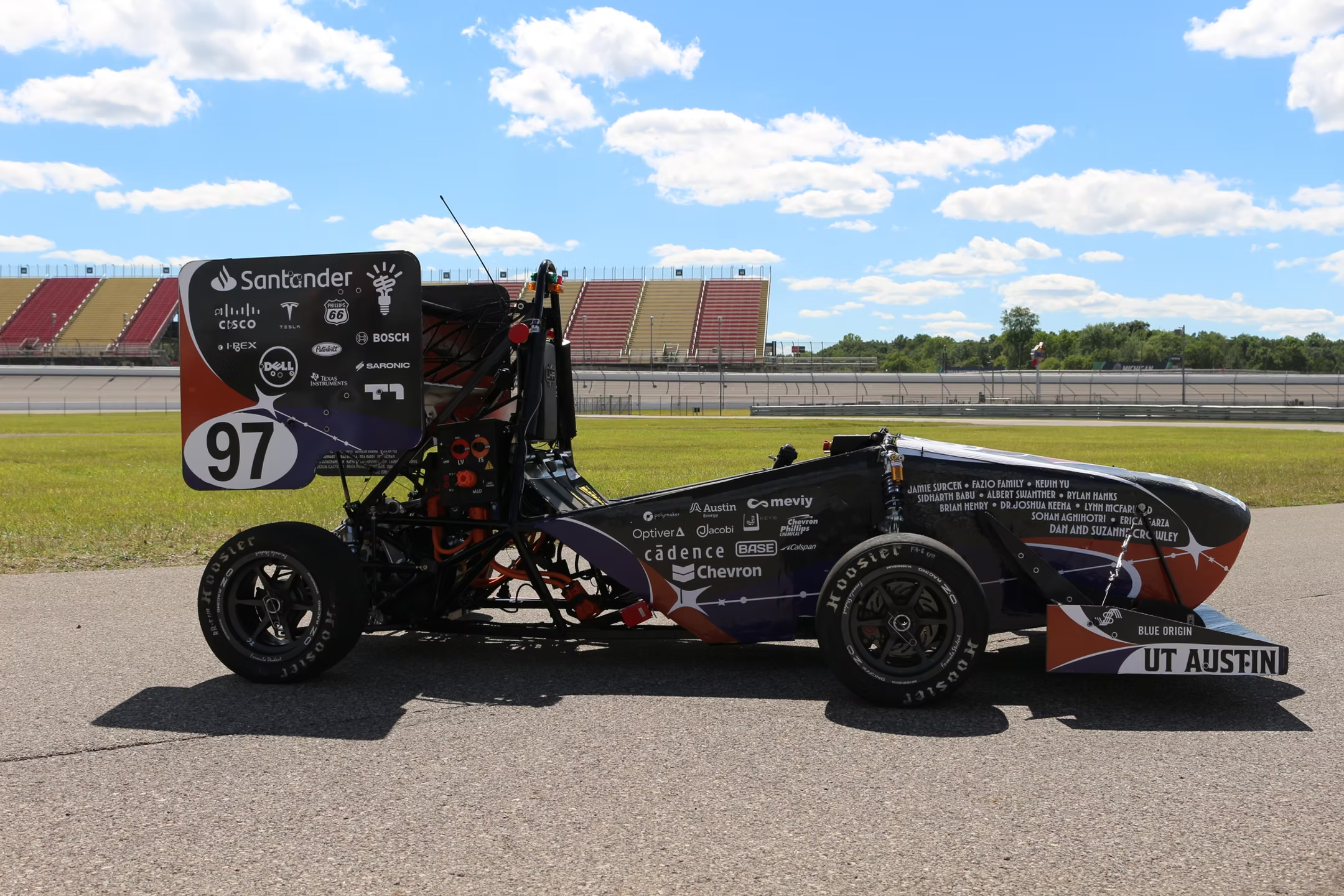
LHReLonghorn Racing Electric (LHRE) designs, builds, and competes with an electric Formula-style racecar every year. We implement a custom high-voltage battery pack, electric motor, power electronics, and controls – with unique challenges in thermal management and drivetrain design. In parallel, our mechanical systems focus on the structural design and vehicle dynamics required to build a lightweight, stiff, and high-performance racecar.
Last season, our car completed over 275 miles of testing – more than any previous LHRE car. This year, we’re building on that reliability and experience with one clear goal: earning a top-five finish at competition.
We have workdays every Sunday from 10 a.m. to 7 p.m., primarily on campus at the Engineering Teaching Center (ETC). In the spring, many systems will move to Pickle Research Campus for electronics manufacturing and vehicle integration. In addition to workdays, members attend weekly system meetings and push designs forward throughout the week to keep pace with our ambitious development timeline.
We’re looking to recruit driven and curious members who will grow into the future leaders of the team. Successful members proactively communicate, ask questions, seek feedback, and push themselves and their teammates to maintain a high standard of engineering.
Beyond the technical work, LHRE is a tight-knit community! From dinner parties to sand volleyball kickbacks, we take time to unwind and build lasting friendships.
We’re excited to see your application, and please don’t hesitate to reach out with any questions!
Systems & Sub-Teams
Aerodynamics
Aero is responsible for both the fluids and composites design + manufacturing of the aerodynamics package. The goal of aerodynamic design is to minimize drag while increasing downforce. Increasing downforce generates more grip, which improves cornering speeds while decreasing drag improves battery efficiency and increases straight line speeds. These goals are all achieved through development of the Front Wing, Undertray, Sidepods, and Rear Wing. We utilize Computation Fluid Dynamics (CFD) to simulate flow fields while iterating through design. We are additionally responsible for the composite (carbon fiber) manufacturing and mounting of the aero package. Mounting designs are simulated using Finite Element Analysis (FEA) to optimize the strength, stiffness, and deformation of aerodynamic components. Members gain experience with CAD, CFD, FEA, composites, machining, and empirical testing to design, manufacture, and validate the effectiveness of our aerodynamics package.
Body
Body is responsible for connecting the team together. Every other system mounts to, packages around, or is driven through something Body designs, so we work with every system on the car. It consists of two subsystems: Frame and Ergonomics. The Frame system designs the chassis and handles packaging, fitting the battery, powertrain, suspension, aero, and driver into a structure that is light, stiff, and compliant with FSAE rules. The Ergonomics system owns the driver interface and brings driver feedback into the design of the car. They design the seat, dash, steering, and controls placement, translating what the driver notices on track into design changes that make the car faster and easier to drive. We manufacture most of what we design in house using tube notching, TIG welding, jigging and fixturing, machining, and carbon fiber layups. Members gain experience with CAD, FEA, hand calculations, load path analysis, welding, machining, and composites to design, build, and validate the structure of the car. We value members who want to understand how the whole car fits together, communicate well across systems, and speak up early when something does not look right.
Dynamics
Vehicle Dynamics makes the car fast. Three subsystems - Suspension, Steering & Brakes, and Unsprung - work together to connect the tires to the the rest of the car while extracting as much performance as possible from them.
Members conduct mechanical design with a focus on ownership through the entire lifecycle of their parts - ideation, CAD, analysis, and manufacturing. Parts are heavily optimized for weight, strength, and stiffness through rigorous, iterative design and cutting edge CNC manufacturing methods. Vehicle Dynamics also has a heavy focus on the drivability and handling mechanics of the car - doing the analysis to build a tight handling, tunable platform that dominates on track.
Members will develop skills for CAD, FEA, Machining, as well as high level vehicle dynamics. We value members who are passionate about mechanical design and analysis, quick and eager to learn, self starters, and above all, we value members who are willing to put in the hours and commit their time to the team.
Electronics
Electronics is responsible for planning, designing, and implementing the electrical systems that power, control, and monitor the car. ELC designs custom electronics and embedded systems responsible for everything from low-voltage power distribution and sensor acquisition to vehicle controls, safety systems, and telemetry. Members design and manufacture PCBs, develop firmware, integrate sensors and actuators, build the vehicle's wiring harness, and test and validate these systems. Some of our custom projects include our Vehicle Control Unit, battery management and high-voltage control electronics, dashboard and driver controls, telemetry hardware, and low-voltage electrical architecture. Members gain hands-on experience with circuit and PCB design, embedded C/C++, microcontrollers, communication protocols, power electronics, electronics manufacturing, debugging, and system-level testing. ELC values members who are passionate about their work, eager to learn a wide range of skills, willing to collaborate with others on difficult projects, and excited to be part of the team, both technically and socially.
Vehicle Modeling & Software
Vehicle Modeling and Software is responsible for developing the software and analytical tools used to gather data from the car, model and understand vehicle behavior, and support engineering decisions across the team. The system is made up of three subsystems: Telemetry, Vehicle Modeling, and Autonomous. Telemetry develops the software stack that transmits vehicle data from the car to a central server and makes it available for real-time monitoring and retrospective analysis during testing and competition. Vehicle Modeling creates models that help the team understand how decisions involving suspension geometry, chassis stiffness, aerodynamics, and other key vehicle specifications affect the car. Autonomous develops the software and designs the autonomous package that will allow the car to drive itself in future Formula SAE autonomous competitions. We value members who are passionate about learning a wide range of concepts, willing to work with others to tackle difficult problems, and motivated to use software and data to make the car better.
Powertrain
Powertrain deals with the parts of the vehicle responsible for the car's propulsion. It is one of the most multidisciplinary systems as it deal with both electrical and mechanical concepts. It consists of three subsystems: Drivetrain, Battery, and Thermals. The Drivetrain system is responsible for designing a reliable and robust method of transmitting torque to the tires. Specifically, they learn to use Finite Element Analysis and material properties to optimize part geometry for weight, strength, and efficiency. The Battery system is responsible for designing a safe and reliable high voltage battery pack and case. Specifically, they utilize a variety of electro-mechanical concepts, mathematical battery models, and CAD modeling to design an efficient battery. The Thermals system is responsible for ensuring the Drivetrain and Battery components stay within their operating temperature range. They perform complex thermal analysis using Computational Fluid Dynamic analysis on different battery cooling solutions. We use a wide range of manufacturing processes to create those parts such as manual and CNC machining, 3D printing, and carbon fiber layups. We value members who are passionate about learning a wide range of concepts, willing to work with others to tackle difficult problems, and chocolate milk connoisseurs.
Trackside Engineering
The Trackside Engineering (TSE) system is responsible for the testing, driver training, and race strategy that turns a running vehicle into a competitive racecar. TSE projects span a wide range of disciplines but all lead back to on-track performance. On the data side, that means choosing sensors, building the tools used to interpret runs, and studying past competition data to shape strategy. Design projects include lap timing devices, camera and sensor mounts, and live telemetry visualization. TSE also selects competitive, team-focused drivers, then trains them into a competition-ready group.
TSE is highly involved any time the car runs. The system plans and runs the testing season — schedule, venue, car and equipment transport, and safety — and maintains the past cars as testbeds for comparison. Members decide which setup changes are worth chasing, document modifications and results, and communicate with the driver during runs.
TSE is unique in the diversity of its projects and its influence on the car's performance; members develop a full picture of the vehicle's design and operation as a result. TSE members are flexible, comfortable across systems, and focused on making the car faster.
Operations
Operations acts as the support system for the design system that build the car. The three systems of Operations are Corporate Relations, Public Relations, and Treasury. Corporate Relations helps the team secure potential donations and partners for funding. This is generally accomplished through presenting, public speaking, and drafting written applications about the car. Public Relations helps create merchandise, create social media posts, and is also responsible for the livery (design) of the car. Treasury is responsible for managing the financials, purchasing, and procurement of parts for the car. Members in Treasury often communicate with the University on tracking orders, ensuring timely purchasing, and tackling complex orders. We are looking for members who are interested in the roles above. We also would love to have creative, ambitious minds who are interested in working within a team, both professionally and socially.