

Choose a team
Longhorn Racing Combustion
LHRcLonghorn Racing Combustion (LHRC) is the inaugural Formula SAE team, the first of its kind that kickstarted the globally renowned FSAE competition founded in 1981 here at the University of Texas at Austin by our very own Ron Matthews. Our members focus on developing an internal combustion powered vehicle by designing, manufacturing, and assembling a composite based aerodynamics package, custom welded steel frame, suspension system, full electronics suite, and powertrain unit. The team also features a full operations crew with both corporate and public relations divisions to ensure that our organization is properly funded and professionally recognized. Each system on our team is distinct with their own challenges to tackle while working towards the end goal of competing in the yearly Formula SAE IC competition. Outside of the technical work, we are a community of close-knit friends that will find the time outside of building a stellar car to chill and relax, through socials and team outings.
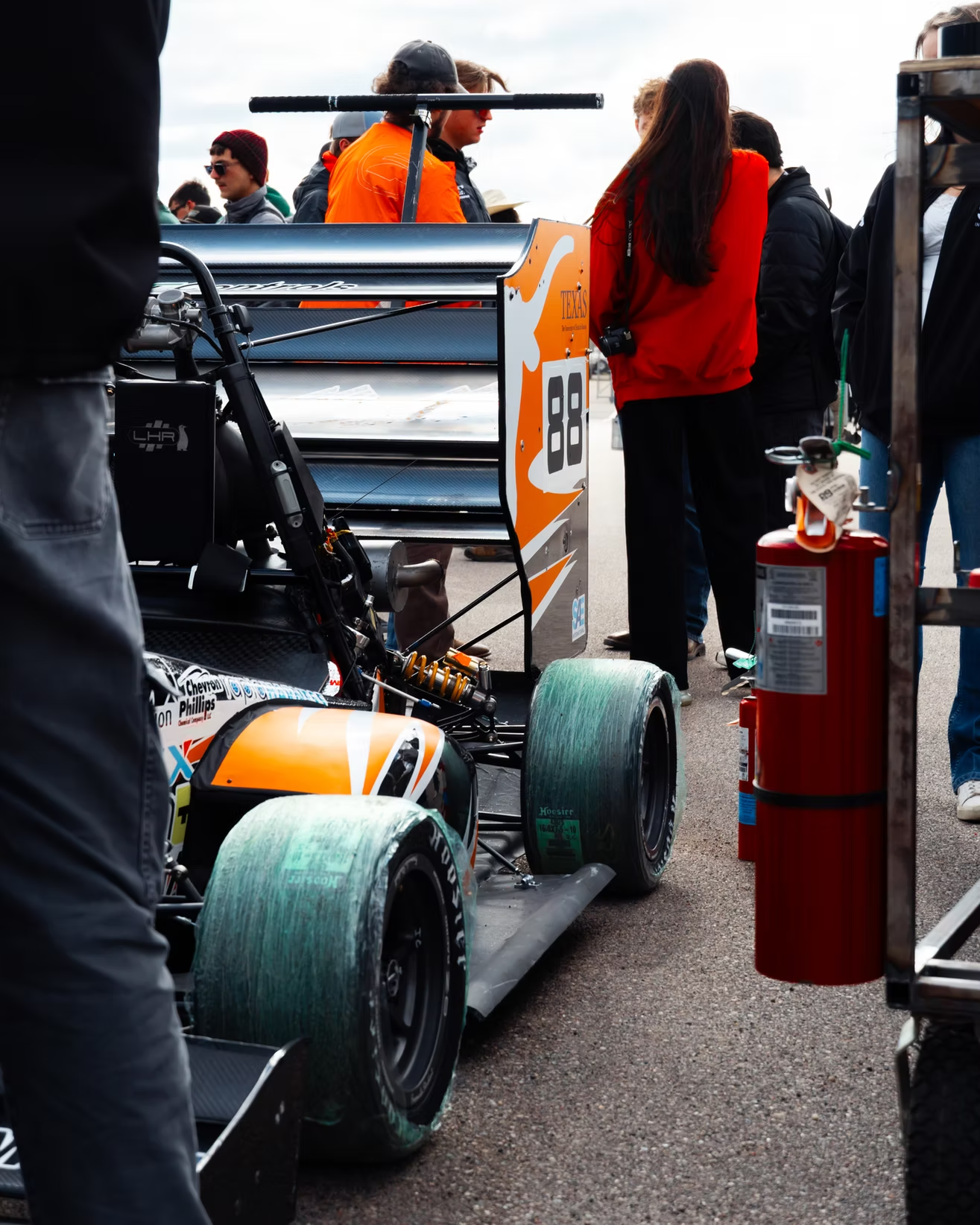
Our workdays are Saturdays from 10:00 AM to 7:00 PM (CST) at the Engineering Teaching Center (ETC). We make full use of the facility space, including the classrooms, ME Department machine shop, and the LHR ETC Garage which includes an electronics design room and an engine dynamometer tuning setup. This past season culminated in the creation of “Penguin”, our premier car powered by a 599cc 93-octane fueled inline-four Honda CBR600RR that hits a peak of 64 horsepower at the wheel. The Combustion team placed 28th overall out of 111 in the FSAE 2026 competition, completing all 4 racing events – acceleration, skidpad, autocross, and endurance along with successfully presenting our methodology to judges. This is the highest we have placed in the previous 4 years, and we plan to continue this performance trajectory.
For this upcoming season, we are recruiting members that are dedicated and willing to step up to this grand engineering challenge. Bring your best curiosity and passion when visiting us at the org recruiting events, as we’re very excited to meet the future of this team.
Come join us and make your mark on FSAE history.
Systems & Sub-Teams
Aerodynamics
The purpose of LHRc’s Aerodynamics system is to redirect airflow around the car to generate downforce and minimize drag while ensuring sufficient cooling to our engine. By guiding airflow, we can push the tires into the ground (downforce), improving lap time and car stability, while also controlling how much air slows the car down (drag). Our Design subsystem focuses on developing the major aerodynamic components: Front Wing, Rear Wing, Undertray, Sidepods, which handle engine cooling, using Computer-Aided Design (CAD) to design and Computational Fluid Dynamics (CFD) to simulate the performance of those designs. Our Testing & Validation subsystem gathers empirical data on our car to validate our CFD predictions using Excel, MATLAB, and/or Python. Lastly, our Software & Automation subsystem builds tools like our own Aero website, using Flask, Linux shell, HTML/CSS/JS, and GitHub, to speed up development and centralize data collection.
Body
LHRc's body system consists of the frame and ergonomics subsystems. The frame team builds the skeleton of the car: a custom-designed, student-welded steel chassis heavily integrated with every system on the team. Static simulations, hands-on welding experience, and opportunities to work with LHRc's many systems are key experiences on the frame subsystem! The ergonomics team is responsible for connecting the driver to the car, designing and building the steering system, the pedal box, seat, and many other assemblies critical for consistent performance. As an ergonomics member, expect heavy physical testing, strong ownership of individual projects, and opportunities to work with our drivers!
Composites
The purpose of LHRc’s Composites system is to create the lightest and strongest vehicle components possible while building a strong foundation in composite material design and manufacturing. The Aerostructures subsystem focuses on the design, analysis, and fabrication of the wing packages, undertray, bodywork, and other aerodynamic components, as well as the mounting structures that support them, while working closely with the Aerodynamics team. The Integration and Test subsystem focuses on developing a knowledge base of composite materials through the research and testing of materials and manufacturing techniques, while integrating composites into other systems by converting previously metal or plastic components, such as the steering wheel, suspension, dashboard, and more, into carbon fiber composites. Members will gain experience designing components and molds in SolidWorks, performing FEA to validate structural performance, and manufacturing parts using both wet layup and prepreg carbon fiber processes. They will also be involved in the complete composite manufacturing workflow, including surfacing, layup preparation, vacuum bagging, curing, trimming, machining, and post-processing.
Dynamics
The Dynamics system designs the car’s suspension, unsprung, steering, and braking systems.The Suspension system covers the vehicle's kinematic design and handling characteristics, using kinematic solvers, custom calculators, and Python/MATLAB scripts to design suspension geometry. They also design a wide variety of suspension components and jigs to validate their design targets. Unsprung is responsible for the unsprung mass (wheels, hubs, uprights) of the car and the braking system. They use simulation softwares like ANSYS and MESYS to optimize part geometry and model key performance characteristics across a sweep of dynamic events. Their wide range of component design allows for innovative manufacturing techniques and analysis methods. Dynamics offers a variety of work, allowing you to develop valuable skills for industry experience. You will have the opportunity to learn 3D modeling software, Finite Element Analysis, test design and development, hands-on manufacturing, coding, GD&T, suspension tuning, and more!
Electronics
The electronics system designs and manufactures the car's custom wiring harnesses and printed circuit boards (PCBs) entirely in-house. In addition to the vital role of developing the car's wiring harness, electronics is divided into two subsystems: hardware and software. Members specialize in one area, but gain experience in both PCB design (using KiCad) and manufacturing, as well as embedded programming primarily in C. PCB applications include but are not limited to, power distribution, powertrain control (such as transmission and ignition), driver interfaces, and data acquisition. Members will work on electronics that power, control, and monitor nearly every aspect of the car, taking projects from schematic design and PCB layout all the way through manufacturing, testing, and validation.
Powertrain
The Powertrain system is responsible for the design and manufacturing of the car's engine, drivetrain, and heat and fluids systems. The engine subsystem handles tuning and optimization of the engine, including custom intake and exhaust design and manufacturing, along with targeted internal modifications to improve engine performance. The drivetrain subsystem designs and manufactures the systems that transmit engine power to the wheels, including differential integration, axle design, differential mounts, and shifting system. The heat and fluids subsystem manages the engine's thermal and fluid systems to ensure reliable performance under race conditions, including proper oiling, fueling, and cooling. If you are interested in hands on engineering work such as building an engine, machining drivetrain components, or designing thermal systems that go straight onto the car, we encourage you to apply to Powertrain IC.
Sim/Val
SimVal’s high level goals are to bridge the gap between design and track performance. Our team works with other systems to develops mathematical models, simulations, and testing procedures to predict vehicle behavior and validate engineering decisions with real-world data. Members work on projects such as lap time simulation, tire modeling, vehicle dynamics analysis, telemetry processing, data visualization, test planning, and drive days. This year specifically we're specifically focusing on data collection and validation. So if you're interested in software, data science, vehicle dynamics, controls, or everything about the car, SimVal offers a unique opportunity to work with almost everything.
Operations
Operations is responsible for everything that happens behind the scenes to keep business procedures running smoothly, as well as managing the team's current and potential partnerships. Operations is made up of three separate systems, Corporate Relations, Public Relations, and Treasury, with each system specializing in different areas. Corporate Relations is responsible for developing and maintaining industry partnerships, carrying out outreach to current and prospective partners, and working closely with technical teams to identify partnership opportunities and fulfill team needs. Corporate Relations also works closely with the Treasury system to coordinate partnership agreements, donations, purchasing requests, and managing the team's finances, ensuring resources are allocated efficiently and financial operations run smoothly. On the other hand, Public Relations is responsible for promoting Longhorn Racing through social media, branding, content creation, merchandise, and other forms of outreach, ensuring the team's achievements, projects, and events are effectively shared with partners, alumni, and the public. Together, these systems build strong partnerships, expand Longhorn Racing's public presence, and ensure the organization's financial and operational processes run smoothly. By working collaboratively and streamlining internal procedures, Operations allows the team to function efficiently, supports every department, and helps Longhorn Racing remain as competitive as possible.
Manufacturing
The Manufacturing system turns CAD files into real parts that go on the car. As a member you will get the opportunity to machine uprights, hubs, differential mounts, stub shafts, and more on CNC mills, CNC lathes, and manual machines before they're proven out on the race track. Members will learn the details of CAM programming, manual machining, and rapid prototyping. If you're interested in working in a hands-on environment and building real parts that race, apply to manufacturing.